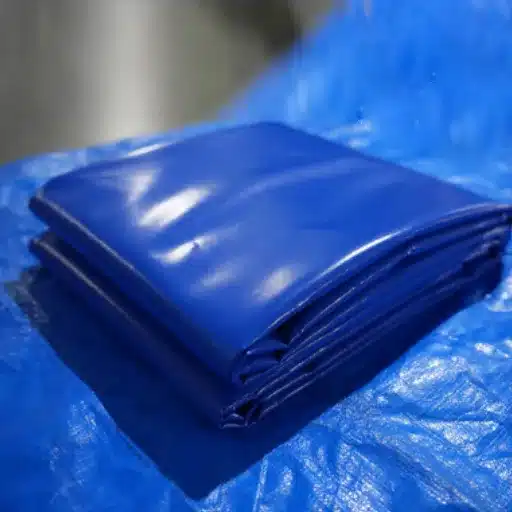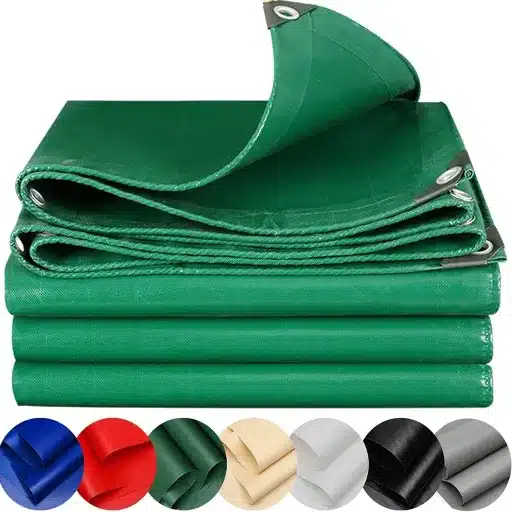
Marcus Patel’s freight transport company suffered a loss of £3,400 when the truck tarpaulin tear failed on the M1 motorway. However, the root cause was not the extreme weather, but rather, some fabric designs which the young man did not comprehend.
If you ever found yourself staring at a supplier’s datasheet pondering about whether 250 Newtons is in any way applicable to the work they are doing, don’t worry. It’s a common thing, the rating of tarpaulin’s tear strength, which is the number one purchasing mistake in B2B material supply that the purchasing managers wish they could have rectified, but for not a goodness of reasons.
This guide does away with such mistaken impressions. It explains the procedures of measuring tear strength, how the values obtained can be applied for PVC, PE and HDPE tarpaulins and how you can trust the information you are given before ordering in large quantities. We’ll also check out some actual application tolerances so that you don’t just settle on what is written on paper.
What Is Tarpaulin Tear Strength and Why Does It Matter?
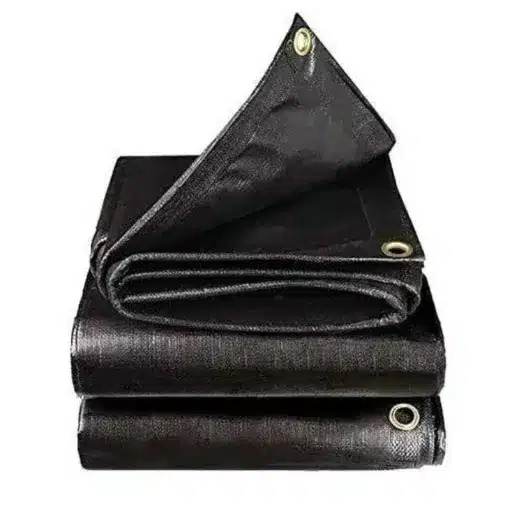
Tearable strength is a property that distinguishes the properties of materials once the tear has already begun. It refers to the force required to tear a fabric further once it has already been punctured. For this reason, it is not the same thing as tensile strength, which is defined as the resistance to a force that is pulling the material across the width of the fabric. Tensile strength can be very high but materials can still tear very easily if the material is torn at the center where it is weakest.
Most tarp uses generate in the market do not undergo failure since one will pull from both ends. Instead, a certain grommet will tear off, a sharp angle will develop a linear rip and wind will cruelly billow out a little scratch into a meter of a rain. If buyers knew how essential tear – the most important of all –strength to be, few people would tend to grip these products even with such unbeatable strength.
The Difference Between Tensile Strength and Tear Strength
Tensile strength refers to the maximum force that a material can handle before breaking. It is the tensile stress that makes it possible to stretch a material to the point of it breaking. When the material is loaded, a very different specific investigation concerning the top opening, mean full opening may also bring the method proposed neck failure more quickly.
With some classes of materials, both tearing and cut propagation are controlled by tensile strength and some geometrical effects. W. BDA provides a high energy rate testing facility to determine the tensile strength of reinforced ‘build’ or composite specimens.
Want to see how different materials perform under stress? Explore our PVC tarpaulin specifications for heavy-duty applications.
How Tarpaulin Tear Strength Is Tested
Reliable suppliers test coated fabrics against internationally recognised standards. The two most common are ISO 4674-1 and ASTM D751. Understanding these methods helps you read lab reports with confidence and spot suppliers who skip proper testing.
ISO 4674-1 Method A: Tongue (Trouser) Tear Test
This would constitute the standard test when using heavy-duty coated tarpaulins. An operator makes a neat incision on the specimen as two separate legs and attaches these to the machine, then detaches them from each other at a constant rate of 100 mm per minute. The equipment benchmarks the energy applied for the achievement of the tear in the given pre-cut area.
However, as it was learned from Centexbel, the Belgian research institute, one should not select the maximum value. Here, the operator takes a four-sectioned force-displacement graph, discards the first and extracts maximum values from the following three sections. This helps in avoiding the initial burst and getting a well-defined propagative value.
The values are expressed in newtons (N) or newtons per meter (N/m). For instance, the results of the use of this technique in case of railway wagon tarpaulin revealed the mean tear strength of 5.73 N/m in terms of the machine direction, while it was 4.49 N/m in the cross direction.
ISO 4674-1 Method B: Elmendorf Pendulum Test
For this test, a pair of sharp pendulum is used for the notched specimen, so that the equipment provides an instantaneous force. It is designed to replicate typical shoe or boot behavior in hitting an obstacle as well as other cyclical stress conditions. This kind of test is particularly appropriate for moderately heavy fabrics and sheeting as opposed to thin plastic films and most sellers of the material do not apply it unless the customer so demands, for instance in avoid any sudden tear.
The results are generally expressed in either millinewtons or grammes-force. Although this test is effective for quality assurance purposes, the Tongue Tear attachment test is the one most preferred for application in the case of industrial fabrics because it better deals with prolonged much of these aesthetic fibers.
ASTM Standards for Coated Fabrics
In North American markets there is specific reference, circumstances existing in the north american market that have led to ASTM D751 being discussed together with its international equivalent, which is ISO 4674-1. It is intended for use in the specification of coated fabrics and includes rainwear or outdoor covering and industrial tarpaulins and also specifies methods of tear resistance including tongue tear and trapezoidal and tack-tear, among others. With these, when a supplier refers to ASTM D751, tape in the correction or collocation of the materials they mean to provide approved propounds under specific tests. One needs to remember that the words, “ASTM D751,” are just words.
How to Read a Tear Strength Test Report
When you receive a lab report, look for these four details:
- Test standard and method (e.g., ISO 4674-1 Method A)
- Specimen dimensions and clamping width
- Direction (warp/longitudinal vs. weft/transverse)
- Unit of measurement (N, N/5cm, or N/mm)
Be careful with units. A value of 250 N/5cm is not the same as 250 N/mm. If a supplier only gives you “250 N” without specifying width or direction, ask for clarification. Reputable manufacturers keep these records for every production batch.
Tarpaulin Tear Strength by Material: PVC vs PE vs HDPE
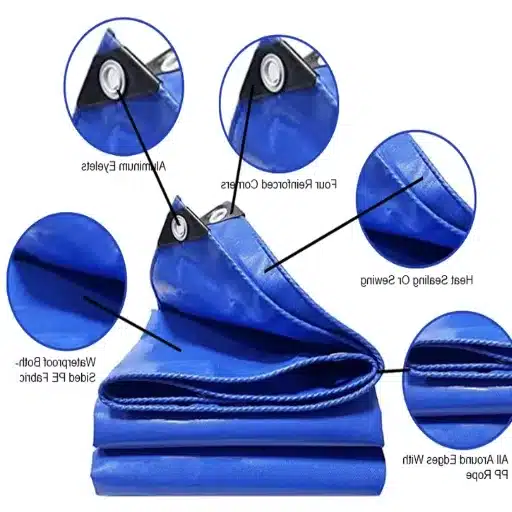
Not all tarpaulins are built the same. The base fabric, coating method, and overall construction determine how a material performs when torn. Here’s how the three most common industrial materials compare.
PVC-Coated Polyester
PVC tarpaulin is made using high-tenacity polyester woven scrim which is coated with PVC paste resin on both sides. Polyester provides strength against tearing from weaving, coated on top of it is a thin layer of PVC that protects against wear and tear from outside factors. Such an arrangement makes it apparent that using PVC would give a stronger tear resistance.
For example, the tear resistance of a PVC tarpaulin weighing 610 g per square meter obtained from Kroftman is equal to 456 N in the warp direction and 314 N in the weft direction. Working with heavier weights of the material increases the resistance to tearing up to 700-1400 N, depending on the cord count and respective coating. In addition, most heavy-duty and severe applications in the likes of Industrial Tents and Long Haul Trucking have PVC materials which have a tear strength that is resistant to stretching that is typically 150 to 200% that of standard PE.
If your project demands maximum durability, our PVC tarpaulin range includes custom specifications with certified test reports.
PE and HDPE Tarpaulins
PE tarpaulin is constructed from HDPE weave embedded with LDPE film. Compared to PVC, it is much easier to stretch, additional, it has less tough layers structure elevated its cost. However a typical multi layer laminate structure is much thinner but more susceptible to tearing, more applied effort especially given, after about a year of outdoor degradation.
Kroftman similar study over the 300 gsm PE tarpaulins found out that the 305N and 233 N warp and weft tear resistances were gained. To the strength by which standard and thermal-PVC tarpaulins are concerned this is diplomatically estimated to be about one-third of that of PVC. There is no doubt in that PE can be applied to the PE plastic tarpaulins. However, due to weight reasons, it may not prove to be very effective as a cover to shield heavy machinery trucks while they are in operation, exposure high wind when on the highways or long routes of transportation of goods, commonly referred to as trucking routes.
You can learn more about PE material properties in our PE tarpaulin guide.
Side-by-Side Comparison
| Property | PE Tarpaulin (300 gsm) | PVC Tarpaulin (610 gsm) |
|---|---|---|
| Tear Resistance (Warp) | 167 N | 456 N |
| Tear Resistance (Weft) | 137 N | 314 N |
| Tensile Strength (Warp) | 1,351 N | 2,965 N |
| Best For | Agriculture, temporary cover, light logistics | Heavy-duty trucking, construction, industrial tents |
| Relative Cost | Lower | Higher |
This table is a useful starting point, but your application may require something in between. Many buyers assume they must choose PE or PVC. In practice, the right choice depends on load conditions, exposure time, and budget. For a deeper comparison, read our article on whether PVC tarpaulin is better than HDPE tarpaulin.
What “Good” Tear Strength Looks Like for Your Application
Numbers on a datasheet only matter when you know what your application demands. Here are practical benchmarks for common B2B use cases.
Construction and Industrial Site Covers
Tarps in the construction sites have an affinity to be affected by sharp edges of equipment, rubbing against scaffoldings and wind exposure. Medium grade covers such as these are recommended to have a higher tear strength ranging from 300 N to 450 N for both the warp and weft. On the other hand, for such applications with heavier long term covering and protecting of machines, anything less than 650 N does not suffice and the common range for these applications are 650 gsm and beyond mainly 900 gsm types of PVC.
Truck and Cargo Covers
Moving at highway speeds brings wind velocity and causes increased stress around grommets and seams. Thus a truck tarpaulin which cannot resist tearing forces up to 150 N will certainly fail to make a 4000 kilometre long trip. In most cases, transport companies tend to ask for not less than 400 N break strength for around the region trips and 600 N above for long trips. This higher strength is justified due to reductions in downtime and protection of goods.
Agriculture and Greenhouse Use
The principal objective in the design of agricultural film covers is the balance between the cost and the UV resistance of the covers against the absolute tear strength. For example, transparent PE-type tarpaulins made of film with a thickness ranging from 130 g/m2 to 200 g/m2 usually have a tear resistance of between 100N and 200N. It is quite suitable for protection of crops in the field, for unloading of loose hay, and for the seasonal use of greenhouses. In the case when the barrier is expected to last for a long period, or will come into contact with livestock, incl. cows and sheep, or will be frequently handled, a layer of Reinforced PE totaling 250 g/m2 or by a light version of 400 g/m2 PVC is advised to be used.
Relief and Temporary Shelter Applications
There are certain limits for humanitarian procurement specifications, especially those pertaining to corrugation since there are specific consequences due to field failures. The International Organization for Migration requests a base-level tear strength of 100 N in the simple PE film used for the usual tent sheets as per ISO 4674-1. U. V.-exposed, standard tents also have heavy duty webbings attached to their perimeter such that these webbings can be pulled even harder than when they are new.
Investigations on using of railway wagon tarpaulins for protective functions under DIN EN ISO 4674-1:2017 revealed the following – the values of 5.73 N/mm in the longitudinal and 4.49 N/mm in the transverse direction of 800 gsm PVC-coated fabric. These unusual conditions are tested by ON-CALL and are not in place for other applications where the railway’s heavy-duty specifications, already adopted by the use of the material, would still be forecasted in better-than-real-life situations.
Need help matching tear strength to your specific project? Contact our team for a customised specification and certified test reports.
Beyond Tear Strength: Related Specs That Matter
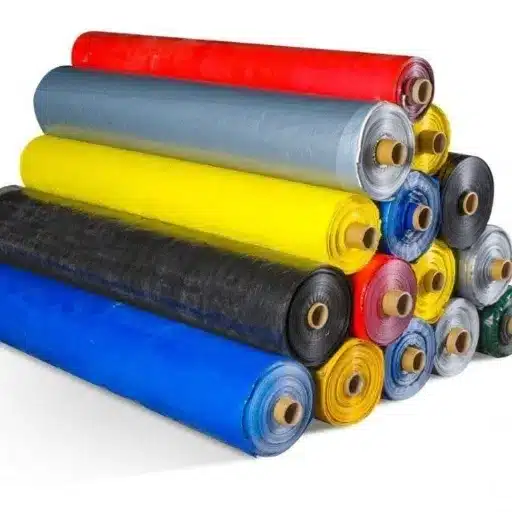
Tear resistance does not exist in isolation. A high tear strength score means little if the coating peels off, the grommets rip out, or UV rays degrade the fibres within a season. Smart buyers evaluate the full specification set.
GSM, Yarn Count, and Weave Density
One measure of textile material density is GSM (gram force per square meter). The higher the GSM, more resistance to both tears and punctures is likely. However, the relationship is not always straightforward. For example, it is possible to find poorly-made tarpaulins with GSM as high as 900 that are more likely to tear than a tightly woven tarp with a GSM of 650.
In addition to the above, the yarn count also plays an important role. And thus, the heavy industrial tarpaulin would often use 1000D – 2000D of polyester yarn that has weave density of 28×26 to 32×32 per inch. Furthermore the high denier and tight weave would mean that the force or stress will be spread widely preventing or reducing tearing.
Reinforced Edges and Grommet Strength
The fabric itself doesn’t usually tear. Instead it’s the edges and the grommet rings that take the most strain mainly in setting and wind actions. Make sure that at least twice stitched or heat sealed folded hems are used. The grommets particularly are inlayed rust resistant aluminum or copper grommets that are at intervals of 0.5 m – 1.0 m with additional reinforcement patches is added at all those points.
There have been cases where the level of grommet reinforcing eyelets was bad and some buyers found damage at 80 N when the UTS of the fabric was 400 N for instance, as a consequence the entire container was rejected. It is crucial to do a grommet strength and the tear test on the base fabric incase gas mistakes are made.
Coating Adhesion and UV Resistance
The necessity of the base fabric and the coating layer amongst covered tarpaulins go a long way to influencing the quality of the said coated tarpaulins. That is, the waterproofing, as well as the protectiveness of the tarpaulins is under threat the moment the coating will delaminate making the fabric tearless. Adhesive force of 120 N/5cm to 200 N/5cm is an average criterion for PVC coated products.
It is also Unfortunate that, in the presence of sunlight, embrittlement which is a condition that intervenes in time and causes tarpaulins to tear with ease is inevitable in swiftly ultraviolet exposed tent covers. The best-quality yard tarps that are intended specifically for exterior use should maintain at 80% of the tensile and tear strengths after some UV testing.
How to Verify Tear Strength When Sourcing from a Manufacturer
Sarah Chen once found herself in a difficult situation – the procurement department of a European construction distributor had to accomplish a lot of work in a very short time frame. One of the cases where acquisition of additional resources was impossible made her think outside the box in order to fulfill the order from the customer. Managing a portfolio of suppliers, she was very careful to inform the customer about the existence of such a weakness in procurement in order to minimize any negative perception. United Kingdom’s construction supplier at the age of 12, she approached informal leaders at school and negotiated on how she could access the romantic corners that they occupied where she aimed at asking them to buy the goods. Becoming the Project Manager of her class at the age of 11, she managed to secure a group of people to give her support in the class and had them helping her deliver the Christmas decorations to the class. However, after the two years, some progress was made in the advertising management. By this time, the young girl’s page that she had made on the internet was getting quite a lot of visitors and consequently trouble.
Questions to Ask Your Supplier
Before you commit to a bulk order, ask these questions:
- Which test standard and method do you use for tear strength?
- Can you provide the full lab report for the production batch, not a generic certificate?
- What are the warp and weft values, and in what units?
- Do you test edges, grommets, and seam strength as well?
- How do you ensure consistency across multiple production runs?
A professional manufacturer should answer these without hesitation. If the responses are vague or delayed, treat it as a red flag.
Sampling and Quality Control Checkpoints
Always request an A4-sized sample before approving mass production. While you cannot run a full ISO lab test on a sample swatch, you can perform simple field checks:
- Manual edge pull: Apply steady force to a cut edge. Quality fabric should resist propagating a small tear.
- Grommet stress test: Pull firmly on a grommet to check if the reinforcement ring holds.
- Visual inspection: Look for even coating, consistent weave density, and clean, reinforced hems.
For large orders, consider appointing a third-party inspection agency to witness testing at the factory. Many buyers arrange pre-shipment inspections where the inspector randomly selects rolls and verifies that lab reports match the actual material.
Ready to source tarpaulin with verified tear strength specifications? Request a custom quote from our team and receive certified test reports with every batch.
Conclusion
Tarpaulin tear strength is not just a number on a datasheet. It is the difference between cargo that arrives dry and damaged goods that cost you thousands. It is the difference between a construction cover that lasts a season and one that rips in the first storm.
Here’s what to remember:
- Tear strength measures resistance to a rip once it starts, which is different from tensile strength.
- ISO 4674-1 Method A (tongue tear) is the standard test for heavy-duty coated fabrics.
- PVC-coated polyester typically delivers 2 to 3 times the tear resistance of PE/HDPE.
- Application benchmarks vary: 100 N for relief tarps, 300 N to 450 N for construction, and 400 N to 600 N plus for trucking.
- Always verify full lab reports, edge reinforcement, and grommet strength alongside the base fabric spec.
Don’t let a confusing spec sheet lead to a field failure. Understand the numbers, match them to your application, and work with a supplier who tests and certifies every batch. Your projects deserve protection that performs under pressure.
Contact Chenlai today to discuss your tear strength requirements and get a tailored quotation with full test documentation.