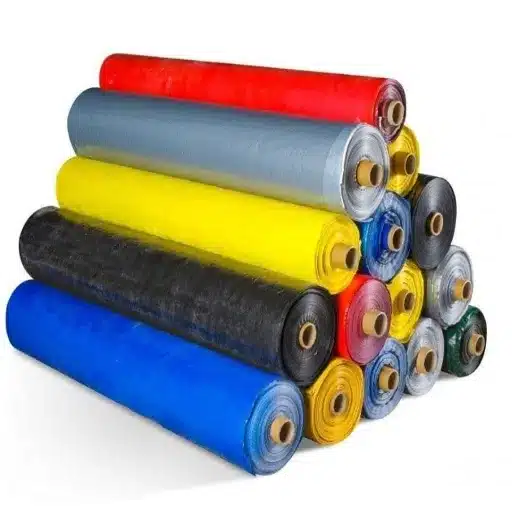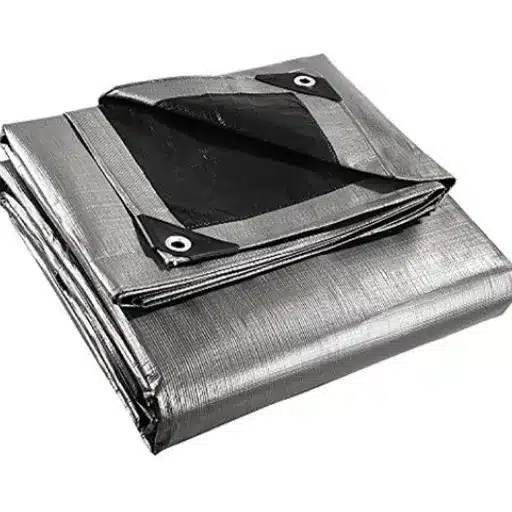
PE tarpaulin wins on cost and portability for short-term projects. PVC tarpaulin wins on durability and safety for long-term industrial use. The right choice depends on your application, environment, and total cost of ownership.
Most buyers make this decision based on price alone. That mistake costs thousands in replacements, labor, and downtime. When a logistics manager in Rotterdam chose PE truck covers to save 40% upfront, he replaced them twice in three years. The PVC option would have lasted eight years with zero downtime.
You already know you need a tarpaulin. This guide gives you the exact framework to choose between PE and PVC without guessing. You will learn how each material performs across twelve technical specifications, which applications demand which material, and how to calculate true cost over five or ten years. We manufacture both materials daily, so the specs and recommendations below come from factory-floor experience, not theory. Still comparing PE and PVC tarpaulins for your project? Contact LY TRUSTLINK for expert recommendations based on your durability, weather resistance, and budget requirements.
Key Takeaways
- PE tarpaulin suits temporary coverage, agriculture, and budget projects with 1-3 year lifespans.
- PVC tarpaulin dominates heavy-duty trucking, construction fire barriers, and permanent installations with 5-10+ year lifespans.
- PVC costs 3-5x more upfront but often delivers lower total cost of ownership for projects lasting over two years.
- PE operates reliably from -15°C to +70°C; PVC remains flexible to -30°C and offers fire retardant certification.
- Both materials support customization, but PVC delivers superior print adhesion, weldability, and hardware strength.
What Is PE Tarpaulin?
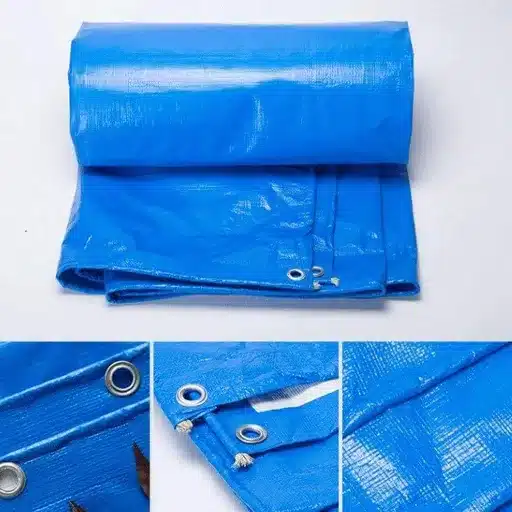
PE tarpaulin is a woven polyethylene fabric laminated with low-density polyethylene (LDPE) coatings on both sides. The base layer uses high-density polyethylene (HDPE) threads woven into a scrim. This scrim provides tensile strength. The LDPE coating creates a continuous waterproof barrier. Learn more about HDPE woven tarpaulin specifications and how this base fabric determines overall strength.
Standard PE tarpaulins range from 50 to 350 GSM. Thickness typically falls between 6 and 30 mil. The material handles temperatures from -15°C to +70°C. It folds easily, weighs little, and transports in compact bundles.
Understanding the PE vs PVC tarpaulin difference starts with manufacturing. At our facility, PE tarpaulin production starts with extruding HDPE tapes. These tapes weave into fabric on circular looms. We then laminate LDPE film onto both surfaces using heat and pressure. UV stabilizers and color masterbatch mix into the coating for outdoor performance. The result is a lightweight, waterproof cover at a competitive price point.
PE tarpaulin, often called a waterproof PE tarp, serves agriculture, construction, camping, and emergency relief. It covers grain piles, protects scaffolding, and lines temporary shelters. For buyers who need reliable protection without heavy investment, PE delivers solid performance. Explore detailed specifications in our complete PE tarpaulin specifications guide.
What Is PVC Tarpaulin?
PVC tarpaulin uses a woven polyester scrim coated with polyvinyl chloride resin. Polyester provides dimensional stability. PVC resin adds waterproofing, chemical resistance, and structural rigidity.
Typical PVC tarpaulins weigh 400 to 1,200 GSM. Thickness ranges from 0.35 mm to 1.0 mm. Operating temperatures span -30°C to +70°C. Fire retardant grades meet B1, M2, NFPA 701, and BS 7837 certifications. Tear strength starts at 1,500 N/5cm and exceeds 3,500 N/5cm in heavy-duty grades.
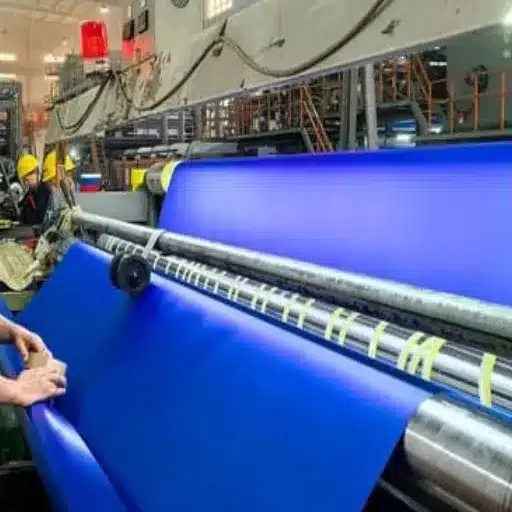
Manufacturing PVC tarpaulin requires knife-coating or calendar-coating equipment. Liquid PVC paste spreads across the polyester base. Multiple passes build thickness and density. Additives enhance UV resistance, flexibility, and flame suppression. The final product welds with heat, creating seams stronger than the base material.
PVC dominates trucking, industrial curtains, tensile structures, and permanent outdoor installations. When evaluating PVC vs PE tarpaulin for demanding environments, PVC’s chemical resistance and weldability are decisive advantages. It resists oil, chemicals, and abrasion. For projects where failure is expensive, PVC is the standard. See our full PVC tarpaulin specifications for technical details.
Head-to-Head Comparison: PE vs PVC Tarpaulin
Choosing between PE and PVC starts with understanding the raw specifications. The table below compares both materials across the metrics that matter for real projects.
| Feature | PE Tarpaulin | PVC Tarpaulin |
|---|---|---|
| Base Fabric | HDPE woven scrim | Woven polyester |
| Coating | LDPE lamination | PVC resin |
| Weight | 50-350 GSM | 400-1,200 GSM |
| Thickness | 6-30 mil | 0.35-1.0 mm |
| Tear Strength | 600-1,300 N/5cm | 1,500-3,500 N/5cm |
| Waterproof Rating | Waterproof | 100% waterproof |
| UV Resistance | Good (with stabilizers) | Excellent |
| Temperature Range | -15°C to +70°C | -30°C to +70°C |
| Fire Resistance | None | Available (B1/M2, NFPA 701) |
| Chemical Resistance | Limited | Excellent |
| Lifespan | 1-3 years | 5-10+ years |
| Flexibility | High (folds easily) | Lower (more rigid) |
| Repairability | Tape or patch | Heat-weldable |
| Recyclability | HDPE widely recyclable | Limited recycling options |
| Cost (per m²) | 0.50−0.50−1.50 | 2.50−2.50−8.00 |
The numbers tell a clear story. PVC delivers roughly 2-3x the tear strength and 3-5x the lifespan. PE delivers 3-5x lower weight and 3-5x lower upfront cost. Neither material is universally superior. The right choice matches the specification to the application.
Want to see how these specs translate to your project? Request a tarpaulin manufacturer consultation with your requirements and we will recommend the exact GSM, finish, and hardware for your application.
PE vs PVC Tarpaulin: When to Choose PE
PE tarpaulin excels in situations where low weight, low cost, and fast deployment matter more than decade-long durability.
Choose PE tarpaulin for:
- Short-term construction and event coverage
- Agriculture and seasonal crop protection
- Disaster relief and emergency shelters
- Budget-conscious projects under two years
Agriculture and Seasonal Coverage
Farmers across Central Asia use PE tarpaulin to cover grain piles during harvest season. The lightweight material spreads quickly over large surfaces. At 80-120 GSM, one worker can handle a 10×12 meter sheet alone. After the season ends, the tarp folds into a compact bundle for storage.
PE also works for greenhouse liners, ground sheets, and equipment covers. UV-stabilized grades last two to three growing seasons before degradation sets in. For seasonal use, replacement is planned and predictable.
Short-Term Construction and Events
Construction sites need temporary weather protection for materials and incomplete structures. PE tarpaulin covers scaffolding, timber stacks, and masonry for six to eighteen months. When the project finishes, the tarp is discarded or recycled.
Event companies use PE for temporary tents, floor covers, and crowd shelters. The low cost makes disposal economical. The light weight reduces transport fees and setup time.
Disaster Relief and Emergency Response
When floods struck parts of South Asia in 2024, relief agencies distributed over 50,000 PE tarpaulins for emergency shelter. The material packed efficiently into cargo planes. Workers with minimal training deployed covers in minutes. PE served its purpose for twelve to eighteen months while permanent housing was rebuilt.
Portability and price make PE the logical choice for humanitarian aid. No one needs a ten-year tarp for a six-month crisis.
Budget-Conscious Projects
Not every project justifies premium materials. The PE vs PVC tarpaulin choice should always begin with an honest assessment of project duration and conditions. A small contractor covering tools overnight does not need PVC. A homeowner protecting patio furniture through winter does not need an industrial-grade coating. PE provides adequate protection at a fraction of the cost.
If your project duration is under two years, environmental exposure is moderate, and fire resistance is not required, PE tarpaulin is probably the right choice. Browse our standard and custom PE tarpaulin sizes.
PE vs PVC Tarpaulin: When to Choose PVC
PVC tarpaulin justifies its higher price in demanding environments where replacement is difficult, failure is costly, or safety regulations apply.
Choose PVC tarpaulin for:
- Daily truck covers and logistics fleets
- Construction fire barriers and long-term enclosures
- Industrial and chemical environments
- Permanent outdoor structures and tensile architecture
Truck Covers and Logistics
A freight operator in Germany learned this lesson the hard way. He fitted his twenty-truck fleet with PE covers to cut costs. Within fourteen months, highway wind speeds tore eyelets from the fabric. Rain damaged electronics cargo. Insurance claims exceeded the original savings. He switched to 650 GSM PVC with reinforced brass grommets. Six years later, the fleet still runs the same covers with only minor repairs.
PVC withstands the constant wind shear and fastening stress of daily trucking. Weldable seams prevent leakage at joints. Fire retardant grades meet European transport safety codes. For logistics companies, PVC is not an expense. It is risk management. See our dedicated truck tarpaulin specifications and fastening options for fleet buyers.
Construction Fire Barriers and Long-Term Enclosures
Construction sites in regulated jurisdictions often require fire-retardant materials. PVC tarpaulin certified to B1 or NFPA 701 satisfies building inspectors. PE has no fire rating and will not pass inspection on sites where codes apply.
Long-term enclosures also favor PVC. Browse our heavy-duty waterproof tarpaulin for construction enclosures with fire-retardant certification. A scaffolding wrap that stays up for three years degrades PE beyond usability. PVC endures UV, thermal cycling, and mechanical abrasion through multi-year projects.
Industrial and Chemical Environments
Oil refineries, chemical plants, and marine facilities expose covers to harsh substances. PVC resists oils, solvents, and saltwater corrosion. PE degrades quickly under chemical contact.
Industrial curtains, warehouse dividers, and equipment shelters benefit from PVC rigidity. The material hangs flat without fluttering. It blocks dust, sparks, and spray. Repair crews heat-weld patches in minutes instead of replacing entire sheets.
Permanent Outdoor Structures
Tensile architecture, event stages, and semi-permanent tents demand PVC. In any PE vs PVC tarpaulin analysis for permanent installation, PVC’s UV stability and weld strength justify the premium. The material maintains color and strength through years of sun exposure. High-frequency welding creates structural joints. Custom shapes and prints turn functional covers into branded installations.
If your project lasts more than two years, faces high winds, requires fire certification, or operates in chemical environments, PVC tarpaulin is the professional choice. Review our heavy-duty PVC tarpaulin options for certified grades and custom fabrication. For buyers comparing heavy duty PVC tarp solutions across multiple vendors, always verify GSM, fire ratings, and weld seam strength before ordering.
Application-by-Application Decision Matrix
The table below matches common applications to the recommended material. Use this as a quick reference when evaluating your project.
| Application | Recommended Material | Rationale |
|---|---|---|
| Construction (short-term) | PE | Cost-effective, adequate protection under 18 months |
| Construction (long-term / fire req.) | PVC | Fire retardant, durable through multi-year exposure |
| Agriculture (crop covers) | PE | Lightweight, seasonal replacement planned |
| Agriculture (greenhouses / permanent) | PVC | Longevity, structural rigidity for framed structures |
| Truck covers (daily use) | PVC | Wind resistance, weldable seams, grommet strength |
| Truck covers (occasional) | PE | Budget option for light cargo and short routes |
| Outdoor events (temporary) | PE | Fast deployment, low cost, easy disposal |
| Outdoor events (stages / floors) | PVC | Print quality, durability under foot traffic |
| Industrial equipment | PVC | Chemical resistance, heat-weldable repairs |
| Disaster relief | PE | Portability, low cost, rapid distribution |
| Marine / coastal | PVC | Saltwater and UV resistance over years |
| Warehouse dividers | PVC | Rigidity, fire resistance, long service life |
This matrix simplifies selection, but every project has unique variables. Wind exposure, fastening methods, and local climate all influence performance.
Cost Analysis: PE vs PVC Tarpaulin Upfront Price vs. Total Cost of Ownership
Price per square meter is the wrong way to compare these materials in a PE vs PVC tarpaulin purchase decision. Smart buyers calculate the total cost of ownership (TCO) over the project lifespan.
Upfront Cost Comparison
Standard 90 GSM PE tarpaulin costs approximately 0.50 to 0.90 per square meter. A mid-grade 650 GSM PVC tarpaulin runs 2.50 to 4.50 per square meter. Heavy-duty PVC grades reach 6.00 to 8.00 per square meter.
On a 500 m² construction enclosure, PE costs 400 upfront.PVCcosts400upfront.PVCcosts2,000 upfront. The PE buyer saves $1,600 on day one.
Replacement and Labor Costs
PE tarpaulin on a construction site lasts 1-3 years. PVC lasts 5-10+ years. Over a decade, the PE buyer purchases and installs three to four sets of covers.
Each replacement requires labor. Removing old tarps, disposing of degraded material, and installing new sheets adds cost. On industrial scaffolding, installation labor can equal material cost. Downtime during replacement delays projects and generates penalties.
Ten-Year TCO Example
Consider a 500 m² logistics cover over ten years:
- PE route: 400initial+400initial+400 replacement (year 2) + 400replacement(year4)+400replacement(year4)+400 replacement (year 6) + 400replacement(year8)+laborforfourswaps=∗∗ 400replacement(year8)+laborforfourswaps=∗∗ 3,200+ total**
- PVC route: 2,000initial+minorweldrepairsovertenyears=∗∗ 2,000initial+minorweldrepairsovertenyears=∗∗ 2,400 total**
The material that cost 5x more upfront becomes 25% cheaper over the project life. Additionally, the PVC cover still has serviceable life remaining at year ten.
When PE Actually Saves Money
PE wins on TCO when project duration is under two years. For a six-month construction phase or single harvest season, PE delivers protection without excess investment. Buying PVC for temporary use wastes capital.
The break-even point usually falls between eighteen and thirty months. Below that, PE is economical. Above that, PVC generates returns.
Need project-specific pricing? Request a custom quote with your dimensions, duration, and application. We will calculate TCO for both materials using current factory pricing.
Customization: How PE and PVC Differ
Both materials support customization, but PE vs PVC tarpaulin capabilities diverge in important ways.
Size and Thickness
PE tarpaulin produces easily in large continuous panels. LDPE lamination accommodates wide widths with consistent coating. PE rolls commonly reach 2-4 meters in width and hundreds of meters in length.
PVC production requires more precise tension control. Large panels demand heavier equipment. However, PVC holds tighter tolerances on thickness and weight. A 650 GSM PVC sheet varies less than +/- 20 GSM across the roll.
Color and Printing
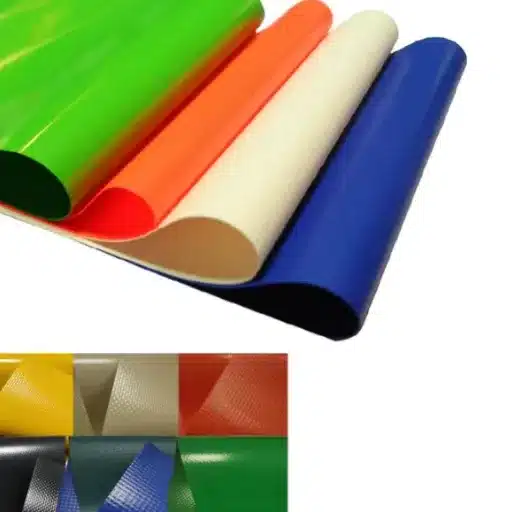
PE accepts standard colors including blue, green, silver, orange, and black. Ink adhesion is adequate for short-term branding. Logos and text remain visible for 1-2 years before fading.
PVC offers broader color matching, including high-visibility shades and custom Pantone matching. The smooth PVC surface bonds ink tenaciously. Screen printing and digital printing last 5+ years without significant degradation. For permanent branded installations, PVC is the only professional choice.
Hardware and Edge Reinforcement
PE tarps use lighter aluminum eyelets. Rope edges and heat-sealed hems provide basic reinforcement. This hardware suits light-duty fastening.
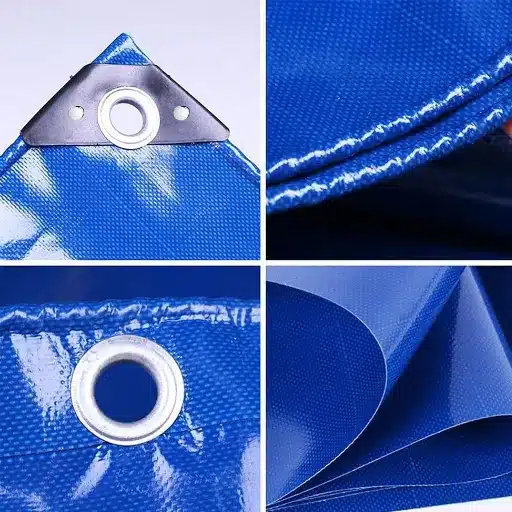
PVC tarps use brass or stainless steel grommets. Welded rope hems and reinforced corners withstand high-tension fastening. On truck covers and tension structures, this hardware difference prevents failure.
Minimum Order Quantities
PE customization typically requires lower MOQs. Standard colors and sizes often start at 1,000-2,000 m². PVC custom orders may require 3,000-5,000 m² depending on specification complexity. Lead times for both materials run 2-4 weeks for standard customization and 4-6 weeks for complex orders.
Environmental Considerations in the PE vs PVC Tarpaulin Decision
Sustainability matters more each year. Buyers in Europe and North America increasingly ask about recyclability and environmental impact.
PE Recyclability
HDPE and LDPE are widely recyclable thermoplastics. Used PE tarps grind, melt, and re-extrude into new products. Collection infrastructure exists in most developed markets. Recycled PE content also works in new tarpaulin production, reducing virgin material demand.
PE production requires less energy than PVC. The simpler extrusion and lamination process generates fewer emissions per square meter. For buyers prioritizing environmental footprint, PE holds advantages.
PVC Environmental Profile
PVC recycling is more complex. Additives, plasticizers, and mixed resin streams complicate reprocessing. Specialized recycling facilities exist but are less common than PE recyclers.
However, PVC lifespan changes the calculation. A PVC tarp that lasts ten years replaces three to four PE tarps. Fewer replacements mean less total material consumption, less transport emissions, and less landfill volume. Over a thirty-year horizon, PVC may generate less cumulative waste despite lower recyclability.
Responsible Sourcing
At our facility, we produce both materials with controlled processes. PE lines use recycled content where specifications allow. PVC lines optimize coating thickness to minimize resin use without sacrificing performance. We pack shipments efficiently to reduce container counts and shipping emissions.
If sustainability is a priority for your project, ask about our recyclable HDPE options. We will balance environmental goals with performance requirements.
Frequently Asked Questions
Which is better, PE or PVC tarpaulin?
The question “which is better PE or PVC tarpaulin” has no universal answer. PE wins for short-term, budget, and lightweight applications. PVC wins for durability, fire resistance, and long-term value. Match the material to your project duration, environment, and budget.
Is PE tarpaulin fully waterproof?
Yes. The LDPE lamination creates a continuous waterproof barrier. Rain, snow, and ground moisture do not penetrate intact PE sheeting. Seams and eyelets are the typical failure points, not the fabric itself.
Can PE tarps be as strong as PVC?
No. In the PE vs PVC tarpaulin strength comparison, maximum PE tear strength reaches approximately 1,300 N/5cm. PVC starts at 1,500 N/5cm and exceeds 3,500 N/5cm in heavy grades. For high-stress applications, PVC is the stronger choice.
Which lasts longer in direct sunlight?
PVC outlasts PE significantly in UV exposure. UV-stabilized PVC performs reliably for 5-10+ years. PE with UV stabilizers lasts 1-3 years depending on latitude and exposure angle.
Is PVC worth the extra cost?
Yes, in most PE vs PVC tarpaulin evaluations for projects lasting more than two years or operating in harsh conditions. The upfront price difference pays back through reduced replacement frequency and lower labor costs. For temporary use under eighteen months, PE is the better value.
Can I use PE for permanent outdoor installation?
Not recommended. UV degradation, wind fatigue, and thermal cycling degrade PE within 1-3 years. Permanent structures require PVC or specialized membrane materials.
Which performs better in cold climates?
PVC remains flexible to -30°C. PE becomes brittle below -15°C and cracks under flexing. For winter construction, cold-storage facilities, or high-altitude installations, PVC is the safer choice.
Can I print logos on both materials?
Yes, but results differ. PVC provides superior ink adhesion, color accuracy, and print longevity. PE supports printing for short-term branding. For permanent signage or branded truck covers, PVC delivers professional results.
Conclusion
PE vs PVC tarpaulin is not a question of good versus bad. It is a question of fit. PE tarpaulin delivers reliable, lightweight, cost-effective protection for temporary and seasonal projects. PVC tarpaulin provides the durability, safety certification, and long-term value that heavy-duty applications demand.
The buyers who save money are not the ones who choose the cheapest material. They are the ones who match material specifications to project realities and calculate true cost over time.
If you are still unsure which material fits your PE vs PVC tarpaulin decision, send us your requirements. We manufacture both PE and PVC tarpaulin daily, and we will recommend the exact specification, GSM, and finish for your application. No generic advice. Just factory-level guidance based on your conditions.
Sources: