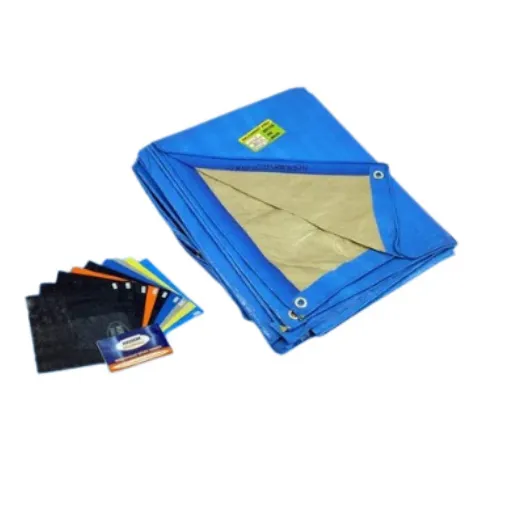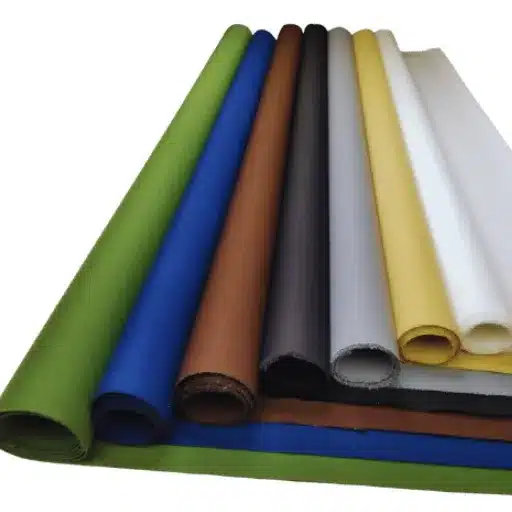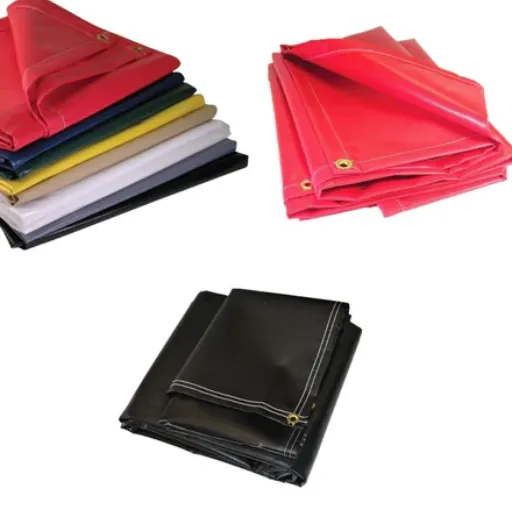
PVC tarpaulin is developed in a woven polyester background tough fabric which is coated with polyvinyl chloride resin. PVC tarpaulin is 100% waterproof, resistant to tears and withstands exposure to temperatures that range from -30°C to +70°C for a duration 5 to 10 years outdoors use. Unlike other low density polyethylene tarpaulins, it has stood out as an ideal solution for hardwearing industrial, transportation and building requirements where failure may not be an option.
Last year, in the attempt to save some money, a logistics manager in Hamburg covered his fleet with standard PE tarpaulin. But then with 6 months, wind and ultraviolet damage made him replace all the covers. “Economics” turned out to be the most expensive for the company and its worth ended up thrice the incurred cost of purchasing PVC tarpaulin at the initial stages.
Such episodes are everyday occurrences. Selecting the unnecessary protective material is not just throwing away money. It is also risking damage to that particular load, incurring delays in the project, and most importantly breaching the health and safety regulations of the premises. For personalized assistance or more details, please contact us via our support page.
Chances are if you are looking to source industrial covers, you have looked at PVC, PE and HDPE. There have been conflicting data in respect to technical parameters. So, what should you know? No more digging into a myriad of technical apk files, cables and equations. In the end, we will determine which parameters are critical for your design, how to differentiate true quality from hype, and prepare important questions to ask the manufacturer before finalizing an order. Those will be the following points.
Under this very heading we shall discuss the material composition as well as the impact of the same on materials’ performance. The scope of the discussion will also include GSM, thickness and tensile strength.
In addition, she states the primary kinds of Polyvinyl Chloride tarpaulin and what the right kind to use is at that time. Also there are cargoes and even whole operations in construction, industry and agriculture that are facilitated by the movements of the vehicle. We delve into the various customization options that most buyers do not really pay attention to. To wrap it up, we teach how to assess a supplier with a view to fine-long term partnership”.
Key Takeaways
- The liner is made of polyester and impregnated with a pvc resin, to finished and sealed water-proof, tear-resistant material that is durable for about 5 to 10 years when used outside.
- The weight can be in a range from 400 up to 1200 g/sq.m., but as a rule in professional sites maximal strength should be not less than 750 GSM.
- Flame retardant material complies with the standards of B1/M2 as well as NFPA 701. This is necessary for construction and tourism industry applications.
- Customization processes allow for alteration in size or shape, altering the color or design in a specific way, stamp printing and also placing grommets, as well as hemming the edges.
- Production companies have the flexibility of working directly with the factory thus getting better quality at very reasonable prices and with low moq as opposed to the trading companies.
Ready to explore specifications? View our full PVC tarpaulin product range for standard sizes, custom options, and sample requests.
What Is PVC Tarpaulin?
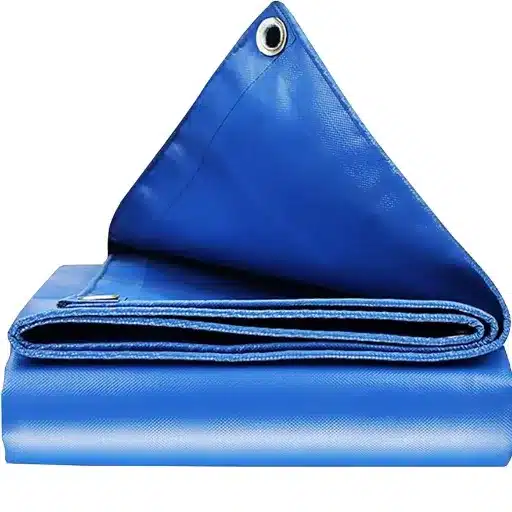
Polyvinyl chloride (PVC) tarpaulin is a specially coated fabric with high performance than the regular ones. Instead of starting with a polymer coated fabric, regular Tarpaulin manufactures would start with a woven polyester base fabric, which will then be coated on both sides with liquid polyvinyl chloride resin. Therefore, what is obtained is essentially a fabric with waterproofness, flexibility, strength and resistant to chemical wear.
The various layer depositions have specific purposes. Typically the base polyester fabric provides all the tensile and shear strength for the tent. Layers like the PVC coating serve other functions such as lining up or care of the fabric. Hence the explicit purpose of PVC is that of sealing the fabric against liquids, which reproduces the natural effect of impregnation. PVC tents do work against water, oil, and grease and most do protect against sun radiation.
For more information, refer to tarpaulin materials on Wikipedia
Further Special finishes like fire retardants, anti-mold coatings and/or uV inhibitors can also be administered.
From 400 to 1200.00 grams abou Standard PVC Tarpaulin will surpass the greatest aUt in value.
They generally range from 0.35 to 1.0mm thicknesses with 500D to 1300D yarn deniers based on whether it serves effecient rigidty for the application.
Take, for example, this PVC tarpaulin with 700 GSM weight which easily serves as a truck’s cover or long construction site. On the same note, the version with 400 GSM will do temporary shelters and agricultural ground sheets much work as it is light duty. This type of polyethylene material comes in several varieties which is why knowing its qualities is necessary before buying any of them. If you have any questions or need further assistance, don’t hesitate to get in touch with us.
How It Is Made
The very first step of the actual to the manufacturing of PVC fabric is the weaving of a polyester yarn to create a fake base fabric. This fabric base determines the fabrics tensile and dimensional quality. Following this, the fabric goes through a coating stage where a layer of heated PVC resin is applied with pressure.
The desired thickness and mass of coating is built up through several passes. In the end, the fabric coated will be taken to the oven for the baking of the resin and after this, some surface treatments e.g. UV stabilisers or anti-fungal agents shall also be applied. Quality control is performed, so as to make sure that the thickness of the roll is uniform.
This given process of creating fabric is the reason why manufacturers that source materials straight from the factory deliver more satisfactory standards than those that extend their sources to trading companies.
Explore our PVC tarpaulin specifications to see standard options and request samples for testing.
What Makes PVC Tarpaulin Different from PE and HDPE?
Not all tarpaulins serve the same purpose. PE tarpaulin is made from woven polyethylene with laminated coatings. HDPE tarpaulin uses high-density polyethylene for improved strength. PVC tarpaulin uses polyester fabric coated with polyvinyl chloride resin.
The differences in material structure create significant performance gaps.
Material Composition at a Glance
| Feature | PVC Tarpaulin | PE Tarpaulin | HDPE Tarpaulin |
|---|---|---|---|
| Base Fabric | Woven Polyester | Woven Polyethylene | Woven HDPE |
| Coating | PVC Resin | PE Lamination | PE Lamination |
| Weight Range | 400–1200 GSM | 60–300 GSM | 80–250 GSM |
| Typical Lifespan | 5–10+ years | 1–3 years | 2–4 years |
| Waterproof Level | 100% Waterproof | Water-Resistant to Waterproof | Water-Resistant |
| UV Resistance | Excellent with stabilizers | Moderate | Moderate to Good |
| Fire Resistance | Available (B1/M2, NFPA 701) | Poor | Poor |
| Chemical Resistance | Oil, acid, grease resistant | Limited | Limited |
| Cost | Higher initial, lower long-term | Low initial cost | Moderate initial cost |
Low-income or short duration uses can be ideal for the use of PE and HDPE also known as polyethylene and high density polyethylene waterproof sheets. This is because they tend to be lighter in weight and much easier to work with. However, they tend to break down much more quickly when exposed to the sun or without any stress. That is where pvc tarpaulin is best used.
When should pvc plastic be selected over the two types of pvc resins on the market? Opt for pvc when you have a site that needs more reliable, resist fire, resist chemical attack and last over 3 years. Opt for pe or hdpe when you need disposable hoods for some light farming tasks or for any use where extreme necessity compels intro of wear that is bound to fail within no time due to very low costs that would be associated with discarding it at that time.
PVC Tarpaulin Specifications Explained
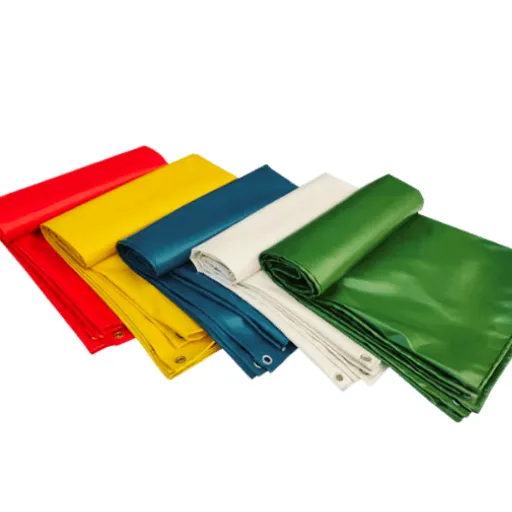
Specifications tell the real story of a tarpaulin’s performance. Marketing claims like “heavy duty” or “super strong” mean nothing without numbers. Here is what each specification measures and why it matters.
GSM (Grams per Square Meter)
GSM is supposed to measure fabric weight with a higher preponderance showing more material and hence greater strength and durability. Above All, PVC Tarpaulin has variations from 400 GSM to 1200 GSM.
The light ones with 400-500 GSM will be used for protecting objects on short term basis, in dividing spaces or at a point when it is raining just slightly. They are called medium duty 550 -700 GSM and they are used in normal construction including agricultural activities and transportation over short distances. Lastly, there are also heavy duty tarpaulins which are rated 750 to 900 GSM and are for industrial equipment, truck tarpaulins which travel long distances and scaffolds which require the whole structure to be covered. Then, only super heavy duty tarpaulins will go up to 900–1200 GSM with terrific things like permanent arc structures, extreme weather; however there are some other concerns like high tension with used tension cables and non-existent standards. If you have any questions or need further assistance, don’t hesitate to get in touch with us.
Thickness
Thickness runs from 0.35 mm to 1.0 mm. Thicker material resists abrasion better and holds up under mechanical stress. However, thickness alone does not guarantee strength. A well-constructed 0.5 mm tarpaulin with high yarn density can outperform a poorly made 0.8 mm sheet.
Yarn Density (Denier)
Yarn density, measured in denier (D), indicates the thickness of individual fibers in the base fabric. PVC tarpaulin typically uses 500D to 1300D polyester yarn. Higher denier means stronger threads and better tear resistance. Transport and industrial applications usually require 1000D or higher.
Tensile Strength
Tensile strength measures how much force the fabric can withstand before breaking. Quality PVC tarpaulin achieves 1500 to 3500 Newtons per 5 centimeters (N/5cm). Truck covers and construction tarps need higher tensile values to resist wind load and mechanical stress.
Tear Strength
Tear strength indicates resistance to ripping once a puncture occurs. Standard PVC tarpaulin offers 200 to 500 N of tear strength. Reinforced edges and hems improve this further. For high-wind applications, look for tear strength above 350 N.
Temperature Range
PVC tarpaulin operates from -30°C to +70°C. At the low end, the material remains flexible and does not crack. At the high end, heat stabilizers prevent the PVC from softening or degrading. Applications in extreme climates should specify temperature-rated formulations. Read about PVC material properties.
Standard Width
Manufacturers produce PVC tarpaulin in rolls ranging from 1.5 meters to 3.2 meters in width. Wider rolls reduce seams in large covers, which improves waterproofing and strength.
Custom widths are available for specialized projects.
View our heavy duty PVC tarpaulin range for specifications starting at 750 GSM.
Types of PVC Tarpaulin
PVC tarpaulin is not a single product. Manufacturers produce several specialized types for different industries and compliance requirements. Choosing the right type prevents costly mistakes.
Heavy Duty PVC Tarpaulin
A big, handling-positive, high-tariff heavy tarp in weight that starts at 750 GSM high denier polyester bond with lockstitched woven reinforced edges. Sufficient to hinder slipping with high winds, rain, abrasion resistance as well as repeated usage. Useful in anvils for curtains for vehicles or machine covers and other temporary buildings when storage in the opened sun is involved.
A civil engineering company in Munich had a problem where the squad had to work inside a scaffolding net for a year and a half on a high rise’s shell. The design adopted heavy duty 900 GSM together with hemmed edges of the PVC material and additionally has double sewn joints. The use of common covers would have seen, the covers breaking during one rainy season. Specially treated membrane remained consistent, solvent-fiberglass blends, covering all places subjected to snow for two winters in which there were heavy rains and the anti-sun property.
Fire Retardant PVC Tarpaulin
One of the key applications of retardant plastic tarp is that it is treated with chemicals that make it fairly difficult to ignite. This does not mean that it will not burn, it simply extinguishes itself, when the source of heat is eradicated.
The main standards that are active in this market are the European B1/M2, the North American NFPA 701, and the EN 13501 for use in buildings. The majority of these standards are required by construction workers, show bias towards steel erectors’ and houses for workers entrance and heras tarp. Ask for the test certificates from your supplier. Do not ever assume that a tarp is fireproof without any details. We value your feedback! Get in touch with us to share your thoughts or ask for help.
Clear PVC Tarpaulin
Clear PVC tarpaulin offers light transmission while maintaining waterproofing and durability. It is ideal for greenhouse panels, outdoor dining enclosures, equipment viewing windows, and tent sidewalls.
Thickness typically ranges from 0.3 mm to 0.5 mm for clear variants.
UV treatment is critical for outdoor clear tarps. Untreated clear PVC yellows and becomes brittle within months of sun exposure. Browse clear PVC tarpaulin options for visibility applications.
PVC Tarpaulin Rolls
PVC tarpaulin rolls supply fabricators, distributors, and manufacturers who cut and weld their own finished products. Standard roll widths range from 1.5 m to 3.2 m. Roll lengths vary by weight and customer requirements.
Buying in roll form reduces per-meter cost for high-volume buyers.
Color and Additive Options
Standard colors include blue, green, gray, white, black, and orange. Custom color matching is available for bulk orders. Additive treatments include UV stabilizers, anti-mildew agents, and cold-crack resistance formulations. Specify your operating environment when ordering so the manufacturer recommends the right formulation. We’re here to help! Feel free to contact our team for more information or support.
Applications and Industries
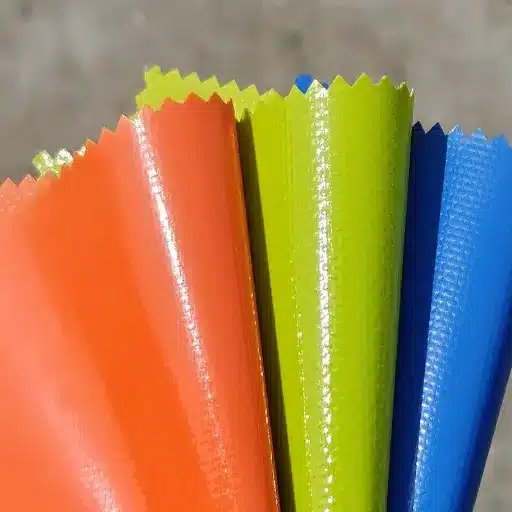
PVC tarpaulin serves diverse industries because it solves one universal problem: protecting assets from environmental damage. Here is how major sectors use it.
Transportation and Logistics
Among PVC tarpaulin’s applications, as one of the highest consumers, is the logistics industry. All types of truck covers, trailer curtains, container tops and cargo curtains depend on the PVC’s strength and waterproof chemical properties. Rainwater penetrating a cracked truck shell may cost hundreds of thousands of dollars in loss should goods be damaged during transit.
PVC tarpaulin is mainly regarded by fleet managers as the material of the car cover that can be repaired or replaced within the admissible repair or replacement limits. If a car cover is of high quality such car cover may serve, let us say, 5 to 8 years and maybe longer. An illegal PE alternative, on the other hand, says around 18 months is good enough, if not short, exceptional terms of service life. Within a fleet of 50 trucks, the cost difference due to replacement, labor, and of course, the time lost, is very high.
Fortification systems matter just as much as the raw material in use. Grommets, D-rings, and rope edges if exposed, however, need to follow the rule of the weakest link. For example, a 900 GSM weight truck cover with a weak weld spots in its eylets will more likely breakdown at the weld spots. Such poor materials should not be allowed to deteriorate the cover, but available equipment should be repaired whenever necessary.
Naval fleet administrators firefighters that space out the hardware elements and their assemblies in light of the above as a countermeasure to deterioration.
Roll format is another consideration for large fleets. Buying PVC tarpaulin in rolls allows in-house fabrication of custom covers for non-standard trailer sizes. This reduces per-unit cost and enables faster replacement of damaged sections without replacing entire covers. View truck tarpaulin specifications for fleet-grade options.
Construction and Industrial
Construction tarps are left out in the open at some construction sites and subjected to the worst weather. Scaffolding screen enclosures, debris netting, equipment tarps, and temporary roofs all encourage longevity. If high-quality and adequately strong polycarbonate tarpaulin is not used, there may easily be many problems, for example, scratches on the moving mats of the scaffolding, too much debris on the sheets, as well as the action of winds incessantly.
Tarpaulins made from PVC with fire retardant qualities are very common in industrial construction sites. In that if it accepts that B1 or NFPA 701 is needed on certain products within some distance of active work. The use of unc ertified enclosures can cause penalties or halt the activity for that day.
In addition, debris elimination finds purpose urgently. Scaffolding sheeting is employed to arrest the entry of the dirt, the paint, and the construction materials into the traffic and reduce dust to pedestrians. The coated fabric is polyvinyl chloride is much stronger to scaffold poles rubbing hence does not wear out as fast as the polyethylene one. As well, RPVC heavy duty protection overlaps during rainy conditions to shield areas in openings, preventing seepage into the interior site work and materials.
Agriculture
For purposes like providing cover against hay, grains; protection for equipment and also sheltering of a certain number of livestock for a period of time, PVC tarpaulins are used by farmers. This becomes evident when one considers the facts that for temporary crop covers, PE and HDPE are used more as opposed to practices in place for long-term and durable storage.
In Spain, a grain cooperative in place of the customary PE covers, opted for the made-to-order PVC tarpaulins of 650 GSM instead. One of the results was that the covers were used up in four rather than just the one season. Indeed, the initial purchase cost was higher although spent each season went down by more than 60%. Upon installation, each cover was custom-fitted to their bin storage on completion, such that there was no room for any moisture to get in between the covers.
Architectural and Recreational
Typically, PVC tarpaulin is installed as the exterior protective fabric of pavilions, marquises, canopies and shelters, however, the material offers some advantages such as the ability to be formed into smooth and tensioned shapes by those who design with it. And as such special features necessitate for the material to withstand specific conditions such as direct intensifying sunrays, which may be mediated through development of UV resistant treatments for such systems.
During the past few years in Europe, the use of inflatable igloos for outdoor dining has become very popular. With the combination of seamless clear PVC side walls fixed to optional existing or new awnings, there is no need for a long and costly extension of the restaurant. The mechanism material’s transparent character allows the guests to enjoy the organic lighting as well as blocking wind and rain. If you have any questions or need further assistance, don’t hesitate to get in touch with us.
Customization Options: How to Specify Exactly What You Need
Off-the-shelf tarpaulins work for some buyers. B2B buyers with specific projects almost always need customization. Understanding what can be customized helps you communicate requirements clearly and avoid miscommunication with manufacturers.
Custom Sizes and Dimensions
Manufacturers can produce PVC tarpaulin in virtually any dimension. Provide exact length, width, and any shape requirements. For fitted covers like truck tarps, precise measurements are critical. Even a 5 cm error can create gaps or tension points that accelerate wear.
Color Matching and Additives
Standard colors are usually in stock. Custom colors require minimum order quantities, typically one roll or more depending on the manufacturer. Specify additive needs upfront: UV stabilizers for tropical climates, cold-crack additives for arctic conditions, anti-mildew treatments for humid environments.
Logo Printing and Branding
OEM customers and distributors often request logo printing. Screen printing and heat-transfer methods apply branding directly to the PVC surface. This is common for rental companies, equipment manufacturers, and private-label distributors who want their brand visible on every cover.
Hardware and Reinforcement
Grommet spacing, reinforced hems, double-stitched edges, D-rings, and rope edges are all customizable. Heavy-duty applications benefit from welded seams rather than stitched ones. Specify the expected load on attachment points so the manufacturer recommends adequate reinforcement.
Roll vs. Finished Sheet
Decide whether you need finished sheets or raw roll material. Finished sheets arrive ready to deploy. Rolls require cutting and welding on your end but offer lower per-square-meter pricing.
Fabricators and manufacturers usually prefer rolls. End users usually prefer finished products.
Contact our team with your project specifications. We produce custom PVC tarpaulin with flexible MOQ and global delivery.
How to Choose a Reliable PVC Tarpaulin Supplier
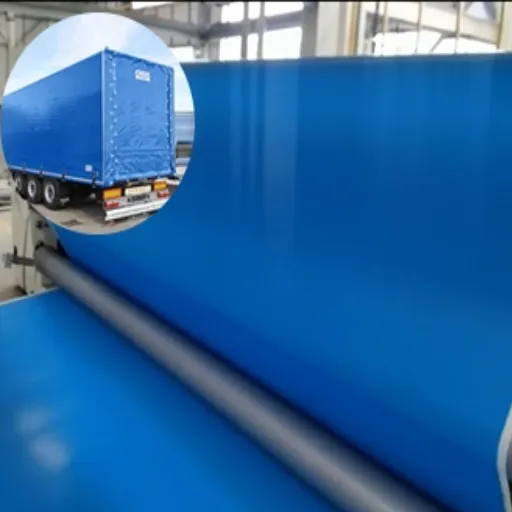
Specifications on paper are meaningless if the manufacturer cannot deliver consistent quality. Here is how to evaluate a PVC tarpaulin supplier before committing.
Verify Material Quality
Ask where the material is sourced from. It is suggested that the best combination of material to be used is pure PVC resin together with yarns containing a high tensile strength. On the other hand, some of the less expensive sources would cut corners, such as including scrap material or lesser quality yarns, which is harmful. The consequences are an uneven thickness, lower tensile strength, and a quicker degradation from the sun.
Please provide me as well as request technical data sheets for the specific item(s) that you consider purchasing. This includes GSM + thickness, tensile strength, tear strength, and working temperature for every possible scenario may be given by a reliable manufacturer. If the supplier in question is unable to supply this information, consider another source for your needs.
Check Production Capability
Tour the factory if possible. Review photos and videos if not. Look for calibrated coating lines, tension-controlled weaving, and quality inspection stations. Manufacturers with automated coating systems achieve more consistent thickness than those applying coatings manually.
Confirm Customization Capability
Not every manufacturer offers full customization. Some produce only standard sizes and colors. If you need custom dimensions, logo printing, or special additives, confirm these capabilities before negotiating price. Ask for samples of previous custom work.
Evaluate Export Experience
One of the key distinctions between professional exporters and those who sell goods exclusively to the domestic market lies in their ability to operate with global logistics. The latter group which has had some experience of dispatching goods overseas will know how to pack goods for sea or air freight, prepare customs papers and understand the basic rules of Incoterms. This includes the procedures of making sure rolls and cartons are well-packed so that they cannot fall and sustain damage or even moisture during long voyage.
Specifically inquire about the routes and approximated transit time of the supplier’s fleet. The company has sizable and regular consignments in Europe, North America and Asia Pacific and has carriage instruments and business-oriented policies in place to appreciate the local rules relating to inbound shipments. They will be able to suggest the best ways of dispatching goods based on the specifications and timeline of the order. If you have any questions or need further assistance, don’t hesitate to get in touch with us.
Request Samples
Always request physical samples before placing a bulk order. Test the sample in your actual application environment. Check flexibility, weight, coating adhesion, and hardware strength. A sample that feels thin, stiff, or poorly coated will not improve in bulk.
Factory-Direct vs. Trading Company
Factory-direct manufacturers control quality, pricing, and lead times. Trading companies add a margin and may not fully understand technical specifications. For consistent bulk supply, factory-direct relationships reduce cost and communication errors.
Maintenance and Expected Lifespan
Even the best PVC tarpaulin benefits from proper care. Simple maintenance routines extend lifespan and protect your investment.
Cleaning
Clean PVC tarpaulin with mild soap and water. Avoid abrasive brushes or harsh chemicals like bleach or ammonia. These degrade the PVC coating and reduce waterproofing. Rinse thoroughly and allow the tarp to dry completely before folding or storing.
Storage
Store PVC tarpaulin in a dry, cool place away from direct sunlight. Fold loosely or roll on a tube to prevent sharp creases. Prolonged folding along the same lines can create weak points. If storing long-term, unroll and inspect the material every few months.
Expected Lifespan by Application
With proper use and storage, PVC tarpaulin lasts 5 to 10 years outdoors. Indoor applications can extend beyond 10 years. High-UV environments, constant abrasion, or extreme temperatures reduce lifespan. Fire retardant additives and UV stabilizers slow degradation but do not stop it entirely.
Repair
Small punctures and tears are repairable. PVC patch kits use adhesive bonding to seal damaged areas. Heat welding provides a stronger repair for larger tears.
Address damage promptly. A small tear grows quickly under wind load or repeated handling.
Frequently Asked Questions
Is PVC tarpaulin waterproof?
Yes. PVC tarpaulin is 100% waterproof. The PVC coating creates a continuous barrier that blocks rain, moisture, and snow. Unlike water-resistant materials that repel light rain, PVC tarpaulin maintains waterproofing even under standing water and prolonged exposure.
How durable is PVC tarpaulin?
Quality PVC tarpaulin lasts 5 to 10 years in outdoor applications. Durability depends on GSM, UV treatment, and maintenance. Heavy duty variants at 750+ GSM withstand abrasion, high winds, and constant handling far better than light duty options.
What is the difference between PVC and vinyl tarpaulin?
There is no difference. “Vinyl tarpaulin” is the common term for PVC-coated fabric, especially in North America. Both refer to polyester fabric coated with polyvinyl chloride resin.
What GSM should I choose?
Choose 400–500 GSM for light duty and temporary covers. Choose 550–700 GSM for general construction and agriculture. Choose 750–900 GSM for heavy duty transport and industrial use. Choose 900–1200 GSM for permanent structures and extreme conditions.
Is PVC tarpaulin fire resistant?
Standard PVC tarpaulin is not fire resistant. However, fire retardant PVC tarpaulin is available with additives that meet B1/M2, NFPA 701, and EN 13501 standards. Always request certification documents if your project requires fire retardancy.
Can I recycle PVC tarpaulin?
PVC recycling requires specialized facilities and is not universally available. However, PVC tarpaulin’s long lifespan reduces replacement waste significantly compared to disposable PE alternatives. Some manufacturers are developing recycling programs for end-of-life PVC products.
How much does PVC tarpaulin cost?
Pricing depends on GSM, dimensions, quantity, and customization. Standard rolls typically cost less per square meter than finished custom sheets. Bulk orders receive volume discounts. Contact a manufacturer directly for accurate pricing based on your specifications.
Can PVC tarpaulin be welded or sewn?
Yes. Both methods work. High-frequency welding creates the strongest bond and is preferred for waterproof seams in truck covers and tents. Sewing with reinforced stitching is common for grommet hems and lighter-duty applications. Welded seams do not leak, while stitched seams may require sealing tape for full waterproofing.
Conclusion
PVC tarpaulin finds applications across various industries, transportation, and for construction in situations that require water proofing, protection against tearing, and service stability. The parameters required may depend on one’s usage, the geographical area and the amount of money involved. Light duty ones, because of their 400 gsm weight, will be good for a short period of time. While, heavy duty covers or gauges at 750 and above give more protection especially when subjected to strong external forces for a longer period.
The focus should be on the work related technical issues of the subject matter. Accurately measure the area under exposure. Check if there is a need to use a fire retardant, UV coating, or materials with special measurements. Afterwards bother to pay visit to those companies responsible for quality management and those that exports they products.
In most cases the cheaper option does not give the best value because the total cost will be one. An eight year old tarp is better than three change overs of a cheaper tarp. Just remember that whatever method is adopted, it will cost installation, hauling out time for torn material, maintenance on, and the damage to machinery.
The true cost of a tarpaulin includes quite a lot more than just the purchase price. Quality pays for itself in reduced downtime, fewer replacements, and protected assets.
Ready to find the right PVC tarpaulin for your project? Explore our full PVC tarpaulin range or contact our team for a custom quote tailored to your exact specifications.